By Masrur Huq, founder of Dynamic.RE · Data as of September 2026
What is a DSCR loan? A DSCR loan is a mortgage for a rental property. It qualifies on the property's rent, not on your income. The lender divides the monthly rent by the full monthly payment. That number is the debt service coverage ratio, or DSCR. Most lenders want it at 1.0 to 1.25 or higher.
Who this helps most: investors buying their first few rentals, especially self-employed buyers whose tax returns understate their income.
The numbers lenders usually ask for:
- DSCR of at least 1.0 to 1.25
- 20% to 25% down
- A credit score of 620 or higher, with better pricing from about 700
- Often a prepayment penalty for the first one to five years
Skip this if you plan to live in the home. DSCR loans are for investment property only.
The rest of this guide shows how lenders run the math. It also shows how to work backward from rent to the highest price that still qualifies.
The same loan rules, two very different answers
Take a typical 3-bedroom in two ZIP codes from our market data.
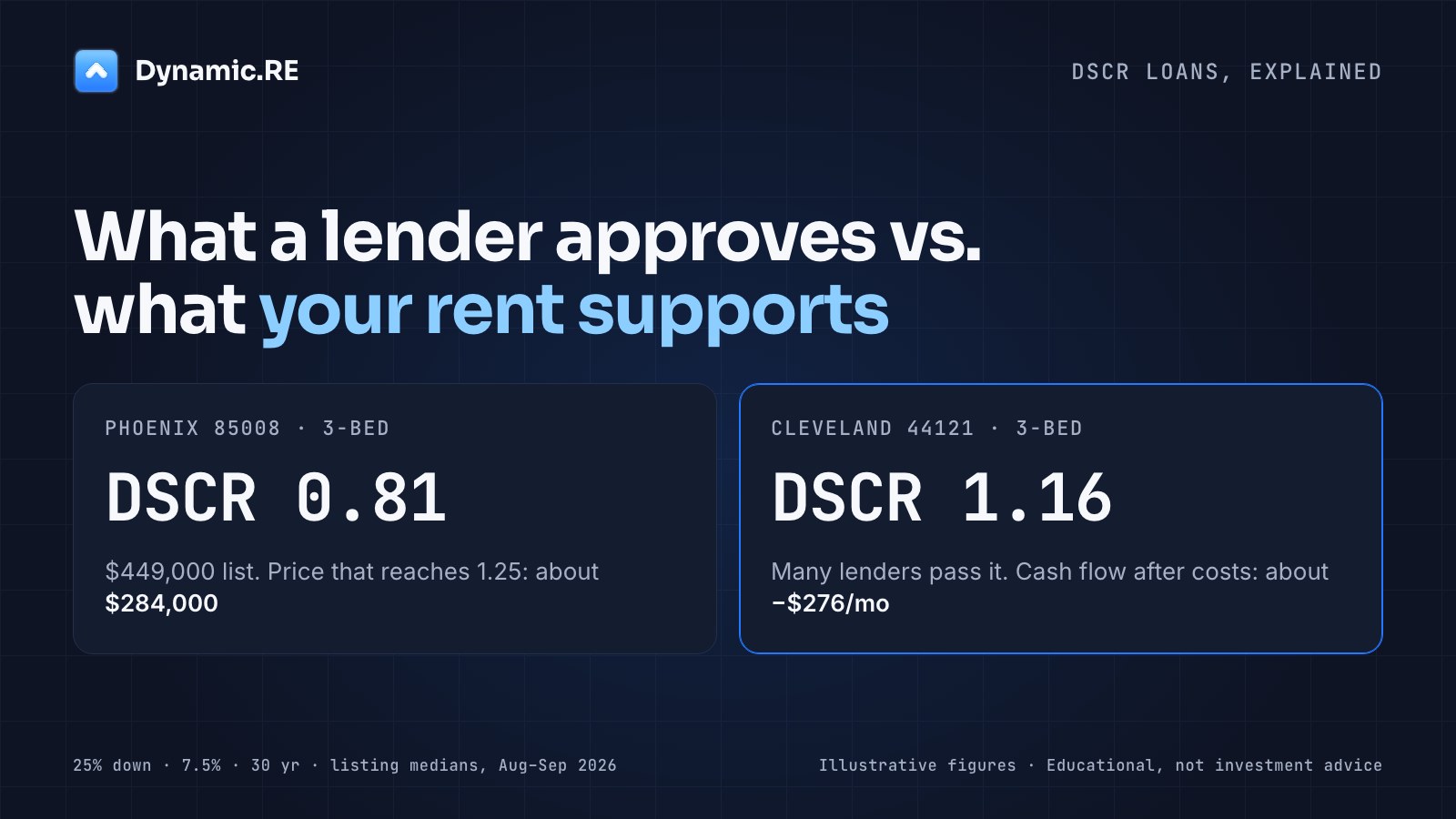
In Phoenix ZIP 85008, the median 3-bedroom lists for $449,000 and rents for $2,195 a month. At 25% down and 7.5%, the DSCR is 0.81. The rent does not cover the payment, so most lenders would say no at that price.
On Cleveland's east side, ZIP 44121, the median 3-bedroom lists for $199,900 and rents for $1,780. Same loan terms, and the DSCR is 1.16. That passes at many lenders. It still loses money each month once you count vacancy and repairs. We'll show both below.
How does a DSCR loan work?
Most lenders for 1–4 unit rentals use one simple formula:
DSCR = monthly rent ÷ monthly PITIA
PITIA is the full monthly payment: principal, interest, property taxes, insurance and any HOA dues.
- A DSCR of 1.0 means the rent exactly covers the payment.
- A DSCR of 1.25 means the rent is 25% higher than the payment.
- A DSCR below 1.0 means you cover the gap yourself each month.
Which rent counts. Lenders usually take the lower of two figures: the current lease, or the appraiser's market rent estimate. That estimate comes from a rent schedule in the appraisal (Fannie Mae Form 1007). If the home is vacant, the appraiser's number is all you get, and some programs cut it by about 5% for vacancy. So underwrite on rent you can prove with comparable rentals, not the seller's flyer. How to estimate rent walks through it.
Some lenders, and most commercial lenders, use net operating income instead of gross rent. That produces a lower ratio. Ask which method your lender uses before you compare quotes.
DSCR loan requirements
Terms vary a lot by lender. These ranges are typical in 2026:
- Minimum DSCR: 1.0 to 1.25. Some lenders go below 1.0 if you put more down or hold more cash reserves.
- Down payment: 20% to 25% is standard. Expect 30% to 35% for a ratio under 1.0 or a credit score near the floor.
- Credit score: 620 is the floor at many lenders. Others start at 660 or 680. Pricing usually improves from about 700 to 720.
- Reserves: several months of PITIA in the bank, set by the lender.
- Prepayment penalty: common for one to five years, often a step-down like 5%, 4%, 3%, 2%, 1% of the balance. Removing it usually costs about 0.25 to 0.50 points on the rate. Some states limit these penalties.
- Borrower: many lenders let you close in an LLC. No W-2s or tax returns are needed to qualify.
Rates run higher than conventional investment loans. You pay for the lighter paperwork.
The highest price your rent supports
The more useful calculation runs backward. Start with the rent you can prove. Then solve for the price that still clears the lender's minimum.
Here is that number for both ZIPs at a 1.25 DSCR, 25% down and a 30-year fixed loan:
- Phoenix 85008 (rent $2,195): about $284,000 at 7.5%. That is $165,000 under the median list price of $449,000.
- Cleveland east side 44121 (rent $1,780): about $183,500 at 7.5%. That is $16,400 under the median list price of $199,900.
The rate moves this number a lot:
- 6.5%: Phoenix 85008 $311,200 · Cleveland 44121 $197,600
- 7.5%: Phoenix 85008 $283,900 · Cleveland 44121 $183,500
- 8.5%: Phoenix 85008 $260,300 · Cleveland 44121 $170,900
Each point of rate takes roughly $25,000 off the Phoenix price and $13,000 off the Cleveland one. So get a rate quote before you write an offer, and run your offer at a full point higher in case the rate moves before closing.
Property tax matters too. We assumed 2.2% of price a year in Cuyahoga County and 0.6% in Maricopa County. That higher tax is a big part of why the cheaper Cleveland house clears only 1.16 at list price.
Why a passing DSCR can still lose money
A lender's DSCR leaves out the costs of owning a rental. It ignores vacancy, repairs, money set aside for a roof or furnace, and property management.
Take the Cleveland house at its $199,900 list price:
- Rent: $1,780 a month
- Full payment (PITIA): $1,540
- Vacancy at 8%: $142
- Repairs at 8%: $142
- Capital reserves at 5%: $89
- Management at 8%: $142
Monthly cash flow: about −$276.
The lender sees a 1.16 DSCR and may approve the loan. You see a rental that costs you about $276 a month. Even at the $183,500 price that hits a 1.25 DSCR, it still runs about $160 a month negative.
With those costs at 29% of rent, the rent has to reach about 1.41 times the payment just to break even. Treat 1.25 as the lender's floor. Your own floor for cash flow is higher.
Run these numbers on any listing with the DSCR calculator, then check cash flow after every expense in the rental property calculator.
DSCR loan vs. conventional loan
A conventional investment loan usually costs less. It qualifies on your income and debts, and it needs tax returns. Fannie Mae also caps how many financed properties one borrower can hold.
A DSCR loan tends to fit when:
- your tax returns show less income than you earn, often because you are self-employed;
- you already hold several financed properties;
- you want to close in an LLC;
- the property's rent clearly covers the payment.
A conventional loan tends to fit when your income is easy to document and you plan to own only a few rentals. Compare both quotes on the same property. The DSCR loan's higher rate lowers the price you can pay.
DSCR loan pros and cons
Pros
- Qualifies on the property, not your pay stubs or tax returns
- Closes in an LLC at many lenders
- No personal debt-to-income test, so it can scale past a handful of rentals
Cons
- Higher rates than conventional investment loans
- 20% to 25% down, and often more for weaker deals
- Prepayment penalties that can cost thousands if you sell or refinance early
- Qualifies on rent alone, which can approve a deal that loses money each month
What would change the answer
- Rent. Every $100 a month of provable rent adds about $11,000 to the Cleveland price at a 1.25 DSCR. A signed lease above market rent may not count if the appraiser's estimate is lower.
- Rate. A point of rate moves the price by $13,000 to $25,000 in these examples.
- Insurance. A quote far above the $1,500 a year assumed here lowers the price you can pay. Get the quote before you offer.
Run your own numbers
Start with the rent. Look up asking rents near the property, then put the listing through the DSCR calculator to see the highest price your target DSCR supports. For a specific address, analyze the property in Dynamic.RE. It shows an estimated rent, HUD fair market rent by bedroom and cash flow. Five analyses a month are free.
How we measured
Rent and price are medians for 3-bedroom listings in each ZIP from Dynamic.RE market data, from the same snapshot. Phoenix 85008: snapshot August 31, 2026, 53 rental and 58 sale listings. Cleveland 44121: snapshot September 1, 2026, 59 rental and 99 sale listings. These are asking rents and list prices. Lease rents and sale prices can differ.
All loan figures are illustrative. They assume 25% down, a 30-year fixed loan, $1,500 a year of insurance, and property tax at 0.6% of price in Maricopa County and 2.2% in Cuyahoga County. Those tax rates are rough assumptions, not measured. Lender terms are typical ranges from published 2026 lender guides and vary by lender.
DSCR loan FAQ
What DSCR do I need for a DSCR loan?
Most lenders want 1.0 to 1.25 or higher. A higher ratio usually gets a lower rate and a smaller down payment.
Can I get a DSCR loan with a DSCR below 1?
Some lenders lend below 1.0 with more cash down or more reserves. The property then needs money from you every month.
Do DSCR loans need tax returns?
Usually not. The lender qualifies the loan on the property's rent and checks your credit, reserves and down payment.
Is a DSCR loan a good idea?
It depends on the deal. It can make sense when your income is hard to document, or when you own several rentals. Check cash flow after every expense first, since the lender's ratio leaves those costs out.
What rent did your lender use for your last DSCR loan: the lease, or the appraiser's number? And how far apart were they? Tell us in the comments.
This content is for informational and educational purposes only and should not be construed as investment, legal, tax, or financial advice. Figures shown are illustrative estimates based on historical market data and assumptions that may not reflect actual results. Real estate investments involve risk, including possible loss of principal. Past performance does not guarantee future results. Investors should conduct their own due diligence and consult qualified advisors before making investment decisions.
Estimated returns, refinance values, and yield ranges are hypothetical illustrations only. Actual results will vary based on financing, market conditions, property condition, operating expenses, and execution.