TL;DR: Small investors with 5 to 50 doors bought nearly 27% of U.S. homes in Q1 2025. They're winning in markets institutions overlook, but only when they underwrite with precision. This article identifies where those markets are, what these investors need to succeed, and why Dynamic.RE was built to give them that edge.
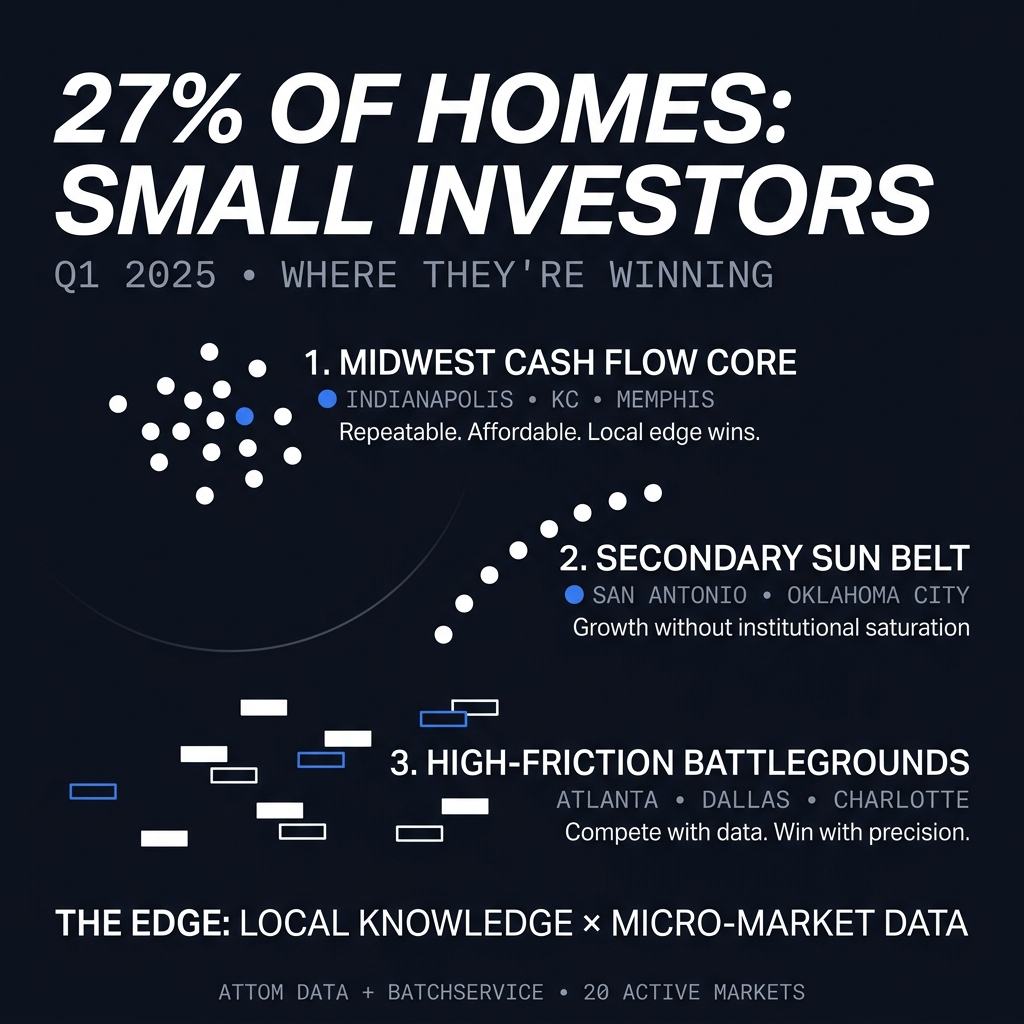
Small investors (5-50 doors) drove roughly 27% of residential home purchases in Q1 2025, per ATTOM Data and BatchService reporting.
Institutional SFR capital is concentrated in Atlanta, Phoenix, Dallas, Charlotte, and Tampa, which creates openings elsewhere.
Markets like Indianapolis, Kansas City, and Memphis reward investors who underwrite accurately, not those who guess.
These investors need rent confidence, block-level risk scoring, true cash flow modeling, rehab realism, and exit flexibility.
Dynamic.RE was built specifically to deliver all of that in one decision engine.
The single-family rental market is no longer just an institutional game.
Investors with 5 to 50 doors bought nearly 27% of homes in Q1 2025, according to ATTOM Data and BatchService reporting. That's not a rounding error. That's a fundamental shift in who controls residential real estate.
Most investor-owned homes sit in the portfolios of small operators, not Wall Street funds. While institutional capital concentrates in specific Sun Belt and Midwest corridors, smaller investors are finding opportunity in the gaps, the overlooked neighborhoods, and the markets where local knowledge still beats algorithmic buying.
The question is no longer whether small investors matter. The question is: where are they winning, and what do they need to keep winning?
The New Competitive Landscape
Institutional single-family rental firms dominate headlines, but their footprint is narrower than most people realize.
Brookings Institution research shows institutional SFR ownership is concentrated in specific Sun Belt and Midwest markets. Atlanta leads. Phoenix, Dallas, Charlotte, and Tampa follow. These are the battlegrounds where smaller investors face the most direct competition from firms with billion-dollar balance sheets.
Concentration creates opportunity elsewhere.
Markets like Indianapolis, Kansas City, Memphis, and St. Louis remain heavily investor-driven, yet accessible. Prices haven't been bid up out of reach. Cash flow is still achievable. The investor infrastructure, agents, lenders, property managers, and wholesalers, is mature enough to support scalable acquisition.
The sweet spot for small investors in 2025 is not where institutions dominate. It's where institutions haven't yet arrived, or where local complexity makes algorithmic buying impractical.
Bottom line: Institutional concentration is a map. The gaps on that map are where smaller investors find their best opportunities.
Twenty Markets Where Small Investors Are Building Portfolios
Not all investor markets are created equal.
Some reward cash flow. Others reward appreciation. Some punish sloppy underwriting. Others forgive it. The best markets for small investors share a few traits: active deal flow, reasonable entry prices, rental demand that holds through economic downturns, and enough variance that local knowledge creates a real edge.
Here's where the 5-50 door investor is finding traction in 2025:
Midwest Cash Flow Markets
Indianapolis remains one of the most repeatable investor markets in the country. Prices are affordable. Neighborhoods are stable. Rental demand is consistent. Investors can build a portfolio here without betting on appreciation.
Kansas City appeared on multiple 2025 investor target lists, including reporting from Realtor.com and Cotality. The metro is still relatively affordable compared to coastal alternatives, and suburban pockets offer strong rent-to-price ratios.
Memphis delivers high cash flow, but it's not forgiving. Block quality varies dramatically. One wrong purchase wipes out a year of returns. Investors who succeed here know how to grade neighborhoods, not just properties.
St. Louis, Cincinnati, Cleveland, Columbus, Detroit, and Pittsburgh share similar characteristics: older housing stock, meaningful neighborhood variance, and cash flow potential for investors who can work through rehab risk and tenant quality.
These markets reward precision. Investors need to know which blocks work, which don't, and why.
Bottom line: Midwest cash flow markets are accessible, but they're not passive. Precision underwriting separates the investors who scale from those who stall.
Secondary Sun Belt Growth Markets
San Antonio offers Texas growth dynamics without the price tags of Austin or Dallas. Property taxes are still a factor, but entry prices remain more accessible for smaller operators.
Houston is massive, diverse, and complicated. Flood risk, insurance costs, and tax resets can damage a deal if not modeled upfront. For investors who stress-test properly, Houston offers volume and variety.
Oklahoma City and Tulsa are gaining attention as landlord-friendly, affordable markets where smaller investors can build repeatable buy boxes without competing directly with institutional capital.
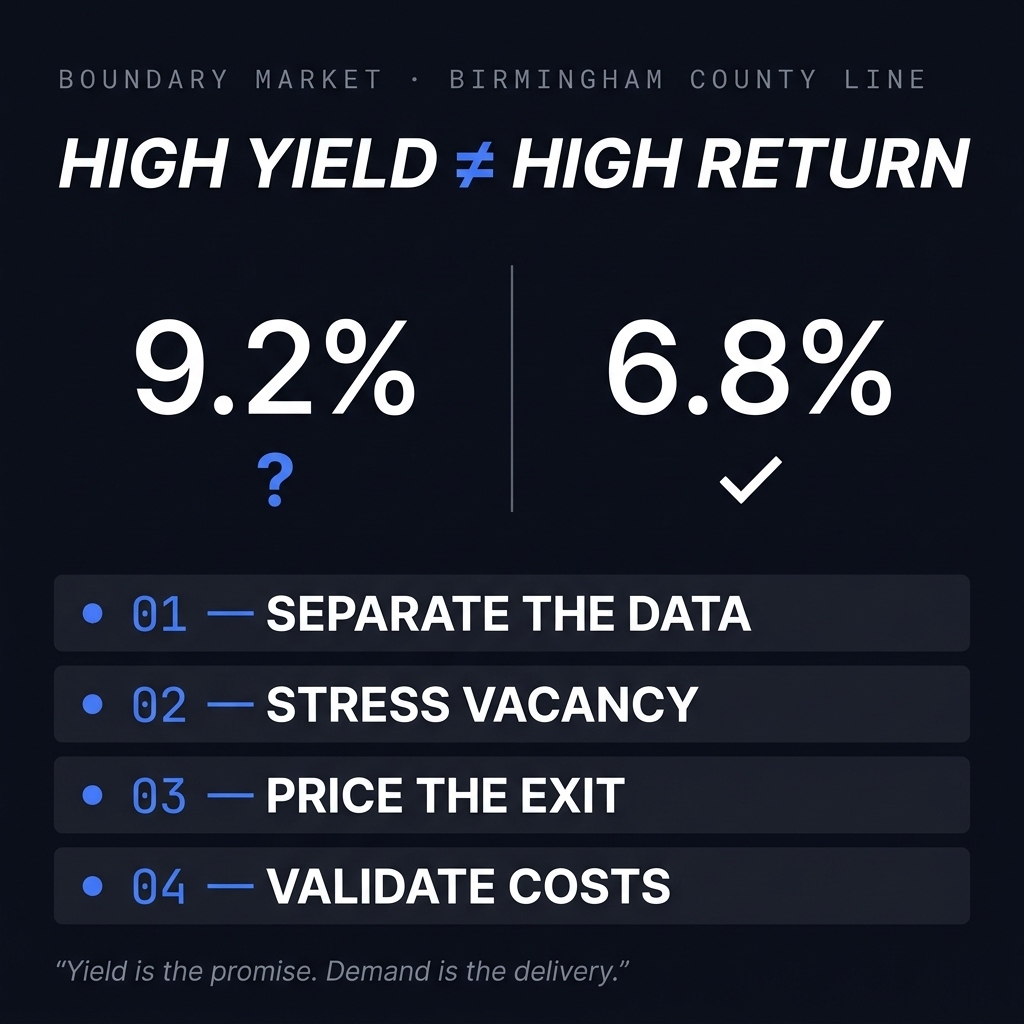
Birmingham and Louisville offer similar appeal: lower acquisition costs, practical rental markets, and less coastal competition.
Bottom line: Secondary Sun Belt markets trade headline growth for accessibility. Investors who stress-test their assumptions upfront tend to find durable returns here.
High-Competition, High-Complexity Markets
Dallas-Fort Worth is one of the largest SFR markets in the country. Deal volume is high. Investor infrastructure is deep. Property taxes are punishing, and margins are thin. Success here requires fast decision-making and submarket intelligence.
Atlanta has the highest institutional SFR concentration in the Brookings data. Smaller investors can still find deals, but they need an edge. That edge is usually neighborhood-level intelligence that algorithms miss.
Charlotte is growing, attractive, and increasingly expensive. Investors who succeed here balance appreciation potential with realistic cash flow expectations.
Jacksonville and Tampa Bay offer Florida rental demand, but insurance, flood risk, HOA fees, and storm exposure complicate underwriting. Florida rentals need to be stress-tested before an offer is made.
Bottom line: High-complexity markets aren't off-limits for small investors. They require a higher standard of due diligence, not a different investment strategy.
What These Investors Actually Need
The 5-50 door investor is not asking theoretical questions.
They're asking: Can I buy this house, rent it quickly, survive surprises, refinance or hold it, and repeat this process ten more times?
That question requires more than a rent estimate and a cap rate.
Rent Confidence
One rent estimate is not enough.
Investors need confidence bands, comparable rentals, days-on-market data, tenant demand signals, and rent-to-income sanity checks. They need to know if the rent is achievable, sustainable, and realistic given local employment and income levels.
Neighborhood Risk Assessment
Crime data, school ratings, owner-renter mix, vacancy rates, investor saturation, and block quality all matter.
In markets like Memphis or Detroit, the difference between a good block and a bad block is two streets. Investors need "do not buy below this street" signals, not citywide averages.
True Monthly Cash Flow
Cash flow projections need to include mortgage payments, DSCR requirements, property tax resets, insurance (including flood and wind where applicable), property management fees, vacancy reserves, maintenance, capital expenditures, HOA fees, and utility responsibilities.
Skipping any of these variables produces fantasy numbers.
Rehab Realism
Investors need to know roof age, HVAC condition, plumbing and electrical status, permit history, and common local rehab costs.
The difference between "light cosmetic" and "money pit" is often buried in property records, contractor estimates, and historical permit data. Investors who underestimate rehab costs lose money before the first tenant moves in.
Exit Options
Not every property is a forever hold.
Investors need to evaluate multiple exit strategies: traditional hold, BRRRR refinance, flip to owner-occupant, seller financing, rent-to-own, Section 8 conversion, or sale to another investor.
The best deals offer multiple viable exits. The worst trap investors into one path.
Portfolio Fit
The question is not just "Is this a good deal?" The question is "Does this deal improve the portfolio, or does it add another headache?"
Investors building portfolios need to evaluate concentration risk, management complexity, financing capacity, and strategic alignment.
Bottom line: The 5-50 door investor needs a decision engine, not a data feed. Every tool should reduce uncertainty and build conviction before the offer goes in.
How to Evaluate Different Market Types
Strategy should match market characteristics. The same buy box rarely works across market types.
For Midwest Cash Flow Markets
Prioritize cash flow accuracy, block risk assessment, rehab cost estimates, rent confidence, and DSCR modeling.
Investors in Indianapolis, Kansas City, St. Louis, Cleveland, Cincinnati, Columbus, Detroit, and Pittsburgh are buying for income, not appreciation. They need tools that prevent mistakes and validate assumptions.
For High-Friction Sun Belt Markets
Prioritize tax and insurance stress tests, institutional competition analysis, appreciation versus cash flow tradeoffs, and suburb-level scoring.
Investors in Atlanta, Charlotte, Dallas, Houston, Jacksonville, and Tampa face higher prices, thinner margins, and more competition. They need to know where growth still leaves room for returns.
For Higher-Risk Yield Markets
Prioritize mistake prevention above all else.
In markets like Memphis, Birmingham, and Detroit, one bad block wipes out a year of returns. Investors need hyper-local intelligence, block quality scoring, crime mapping, and tenant demand validation.
The goal is clear: avoid the deals that look good on paper but fail in reality.
Bottom line: Market type determines which risks to underwrite first. Investors who match their analysis framework to their target market make faster, more confident decisions.
The Shift from Broad Trends to Micro-Market Precision
National headlines about investor activity are interesting.
But they don't help an investor decide whether to buy 1427 Maple Street.
The maturation of the small investor market is driving demand for granular, property-specific intelligence. Investors are no longer satisfied with citywide averages. They want ZIP-code analysis. Block-level risk scoring. Comparable rent data from the actual neighborhood, not the metro area.
This shift reflects a broader reality: real estate investing is becoming more data-driven, more precise, and more competitive.
The investors who win are the ones who analyze faster, underwrite more accurately, and avoid mistakes that others miss.
Bottom line: The edge in today's market is not access to more data. It's the ability to turn the right data into a clear, fast decision.
What This Means for Real Estate Intelligence Platforms — And Why We Built Dynamic.RE
The small investor segment is large, active, and fundamentally underserved by the tools that exist today.
These investors are not asking for more data. They're asking for better decisions. That distinction is exactly why Dynamic.RE exists.
Dynamic.RE is built to do precisely what the market demands: integrate rent confidence, neighborhood risk scoring, true cash flow modeling, rehab cost estimation, and exit strategy analysis into a single, unified decision engine, purpose-built for the 5-50 door investor.
Not another data dump. Not another dashboard to interpret alone. A platform that translates complexity into clarity, and clarity into action.
Every feature on Dynamic.RE answers one question: "Should I buy this property?" With the rigor of institutional underwriting and the accessibility every independent investor deserves.
Quickly. Accurately. Without noise.
The investors in this article, building portfolios in Indianapolis, grading blocks in Memphis, stress-testing insurance in Tampa, are the investors Dynamic.RE was designed to serve.
If that's you, explore what Dynamic.RE can do for your next acquisition.
Final Observations
The 5-50 door investor is not a niche.
This segment drives a significant portion of residential real estate transactions, operates in diverse markets, and needs sophisticated tools to compete effectively.
Institutional capital is concentrated. Local knowledge is distributed. The investors who combine data-driven analysis with on-the-ground intelligence are building portfolios that survive market cycles.
The opportunity is not in chasing the hottest market. It's in knowing which deals work, which don't, and why, before making an offer.
That's the edge small investors need. And that's the gap Dynamic.RE is built to fill.
Key Takeaways
Small investors (5-50 doors) account for nearly 27% of U.S. residential home purchases, making this segment too large to ignore.
Institutional SFR capital is geographically concentrated, and that concentration creates strategic openings for smaller operators in less saturated markets.
Midwest cash flow markets reward precision. Sun Belt markets reward stress-testing. High-risk yield markets require hyper-local intelligence.
Accurate underwriting requires rent confidence, neighborhood risk scoring, true cash flow modeling, rehab realism, exit flexibility, and portfolio fit analysis.
Investors who move from citywide averages to block-level precision have a measurable advantage in deal selection and risk mitigation.
The winning edge is not more data. It's faster, clearer decisions built on the right data.
Dynamic.RE is built to deliver that edge, one acquisition at a time.
Frequently Asked Questions
Where are small real estate investors finding the best opportunities in 2025?
Small investors are finding the best opportunities in markets where institutional capital hasn't concentrated. Midwest markets like Indianapolis, Kansas City, and Memphis offer accessible entry prices and cash flow potential. Secondary Sun Belt markets like San Antonio, Oklahoma City, and Birmingham offer growth dynamics with less institutional competition.
What makes Midwest markets attractive for the 5-50 door investor?
Midwest markets offer affordable acquisition prices, stable rental demand, and mature investor infrastructure. Cash flow is achievable without relying on appreciation. The key risk is neighborhood variance, which makes block-level analysis essential.
Why do institutional investors concentrate in specific markets?
Institutional SFR firms target markets with high deal volume, scalable acquisition processes, and strong population growth. According to Brookings Institution research, Atlanta, Phoenix, Dallas, Charlotte, and Tampa carry the highest institutional concentration. This geographic focus creates opportunity gaps elsewhere.
What data does a small real estate investor need to underwrite a deal accurately?
Accurate underwriting requires rent confidence intervals, neighborhood risk scoring, full cash flow modeling (including taxes, insurance, vacancy, maintenance, and capital expenditures), rehab cost estimates, and exit strategy analysis. A single rent estimate and cap rate are not sufficient.
How does block-level risk scoring differ from citywide market analysis?
Citywide analysis provides averages that mask local variance. Block-level scoring identifies specific streets, ZIP codes, and micro-markets where rental demand, crime, tenant quality, and vacancy rates diverge significantly from the metro mean. In markets like Memphis or Detroit, this distinction determines whether a deal succeeds or fails.
What exit strategies should a real estate investor evaluate before purchasing?
Investors should evaluate traditional hold, BRRRR refinance, flip to owner-occupant, seller financing, rent-to-own, Section 8 conversion, and sale to another investor. Deals that support multiple viable exit paths carry less execution risk.
What is Dynamic.RE and who is it built for?
Dynamic.RE is a real estate decision engine built for single-family investors managing 5 to 50 doors. It integrates rent confidence, neighborhood risk scoring, true cash flow modeling, rehab cost estimation, and exit strategy analysis into a single platform designed to answer one question: should I buy this property?
How does micro-market precision improve investment outcomes?
Investors who analyze at the ZIP code and block level can identify deals that citywide data would obscure and avoid risks that metro-level averages would hide. Precision at the micro-market level reduces underwriting error, improves rent accuracy, and supports better portfolio construction decisions.
This content is for informational and educational purposes only and should not be construed as investment, legal, tax, or financial advice. Figures shown are illustrative estimates based on historical market data and assumptions that may not reflect actual results. Real estate investments involve risk, including possible loss of principal. Past performance does not guarantee future results. Investors should conduct their own due diligence and consult qualified advisors before making investment decisions.