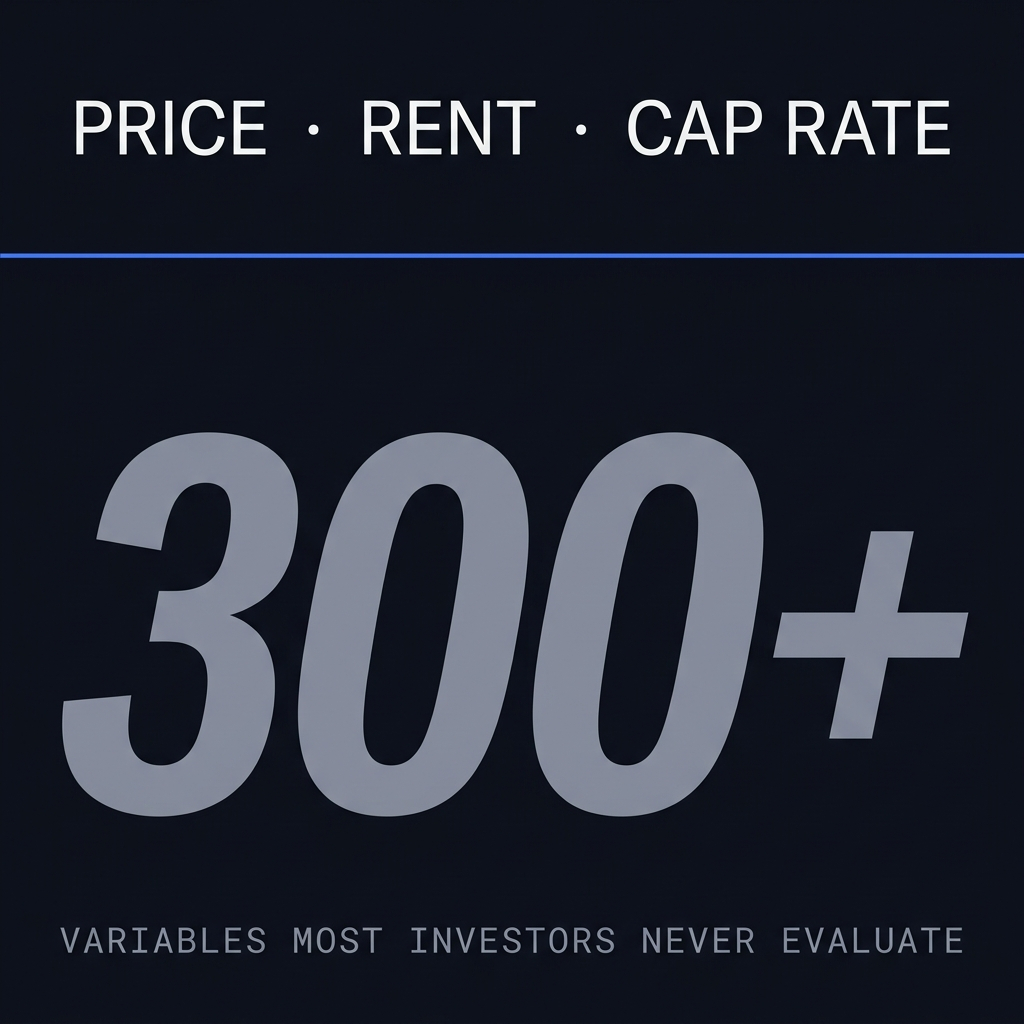
TL;DR: Most residential investors focus on price, rent, and cap rate while ignoring the 300+ variables that actually determine whether a deal works. The Investor Operating Matrix maps all of them, from market selection to disposition, so investors can make genuinely informed decisions instead of discovering blind spots after closing.
At a Glance:
Asset class (not property type) determines tenant profile, rent stability, and capex risk.
Acquisition method sets cost basis and constrains future refinancing and exit options.
Cap rates are a comparison tool, not a decision tool.
Regulatory climate is one of the most underweighted variables in real estate underwriting.
Experience level should dictate which strategies are appropriate. Advanced tools carry higher risk in inexperienced hands.
Most residential real estate decisions collapse into two or three visible numbers.
Price. Rent. Maybe a cap rate if you're being thorough.
The rest sits underneath, unexamined, quietly determining whether the deal actually works. A property's asset class limits which tenant profile and rent stability are realistic. Its acquisition method sets a cost basis that constrains its eventual exit. Its market's regulatory climate determines how quickly a bad tenant situation gets resolved.
None of this shows up in a rent-to-price ratio.
But all of it shows up eventually, usually at the point where it's expensive to fix.
This is the core problem the Investor Operating Matrix addresses. It's a complete system map of the decisions a residential investor actually makes, from market selection through disposition: 14 categories, more than 80 sub-strategies, and roughly 300 individual variables.
The goal isn't to make investing more complicated. It's the opposite.
Making the full set of variables visible up front is what makes a decision genuinely simple to reason about, rather than simple because half the picture was left out.
The Illusion of Simplicity
Real estate education often presents investing as a sequence: find a property, run the numbers, make an offer, close the deal.
A checklist.
The problem is that real investing doesn't work that way. Market selection changes what financing makes sense. Financing changes what exit is viable. Exit strategy changes what value-add is worth pursuing.
These variables move together, not in a line.
A linear checklist breaks down the first time two decisions pull against each other. You discover that the seller's equity position makes your preferred acquisition method mathematically impossible. Or that the regulatory climate in your target market extends eviction timelines so far that your tenant screening criteria need to be completely rethought.
The matrix makes the full set of options visible at once, organized by category, so the connections between them get evaluated deliberately instead of discovered by accident.
Research confirms this isn't theoretical. Approximately 45.8% of real estate and rental businesses fail within the first five years, often due to unforeseen expenses and inadequate planning.
Most failures trace back to poor planning, weak financial assumptions, and insufficient market research — not the asset itself.
Bottom line: Checklists create the illusion of rigor. The matrix builds the real thing.
Asset Class Drives Strategy More Than Property Type
One of the most common category collapses happens when investors conflate property type with asset class.
"I buy duplexes" sounds like a strategy. It isn't one.
A duplex and a single-family home in the same B-class neighborhood share more in common, including tenant profile, rent stability, and capex risk, than an A-class and C-class property of the identical type.
Asset class is the variable that determines the business you're actually running.
An A-class asset attracts high-income professionals with strong credit. Rent stability is very high. Near-term capex risk is low, though replacement costs long-term are high. The typical strategy is buy-and-hold or new construction.
A C-class asset serves service workers with lower-middle income and higher turnover. Rent stability is moderate with more vacancy risk. Capex risk is high, with frequent repairs and turnover costs. The typical strategy is flip, BRRRR, Section 8, or cash flow play.
Same property type. Completely different businesses.
As investment research confirms, asset classes group properties by how they are used and how they generate returns, and this distinction drives the investment decision because residential, commercial, industrial, and specialty properties behave differently across market cycles.
An investor's stated strategy, "I do buy-and-hold," is incomplete without an asset class attached to it. Buy-and-hold on an A-class asset and buy-and-hold on a C-class asset require different tenant management intensity, different capex reserves, and different vacancy assumptions, even though the label is the same.
Key Point: Knowing your asset class isn't a detail. It's the foundation every other decision gets built on.
Acquisition Method Sets the Basis, and the Basis Sets the Exit
How a property is bought isn't just a closing mechanic.
It determines cost basis, how much flexibility exists later, and which exits are mathematically available.
A deal bought subject-to an existing mortgage carries different refinancing and disposition constraints than one bought with a DSCR loan. A property acquired through seller financing with a balloon payment due in five years has a forced exit timeline that a free-and-clear cash purchase doesn't.
The acquisition method chosen doesn't just close the deal. It sets the cost basis and lien position that constrain every later refinance or resale.
This is why seller motivation and acquisition method should be chosen together, not separately.
A low-equity, financially distressed seller often can't accept the kind of cash discount a direct-to-seller offer assumes, because the proceeds wouldn't cover the payoff. That combination tends to push naturally toward a creative or seller-financed structure instead.
The seller's equity position effectively pre-selects a narrower set of viable acquisition methods. Understanding this connection up front prevents deals from stalling midway through negotiation when the math doesn't work.
Key Point: Acquisition method and exit strategy aren't separate decisions. They're the same decision made at two different points in time.
The Cap Rate Limitation
Cap rates are one of the most commonly cited metrics in real estate analysis.
They're also one of the most incomplete.
As financing experts note, cap rates ignore how you plan to finance the property. They don't account for mortgage payments, debt service, or depreciation, making them useful for comparing properties but insufficient for understanding actual returns.
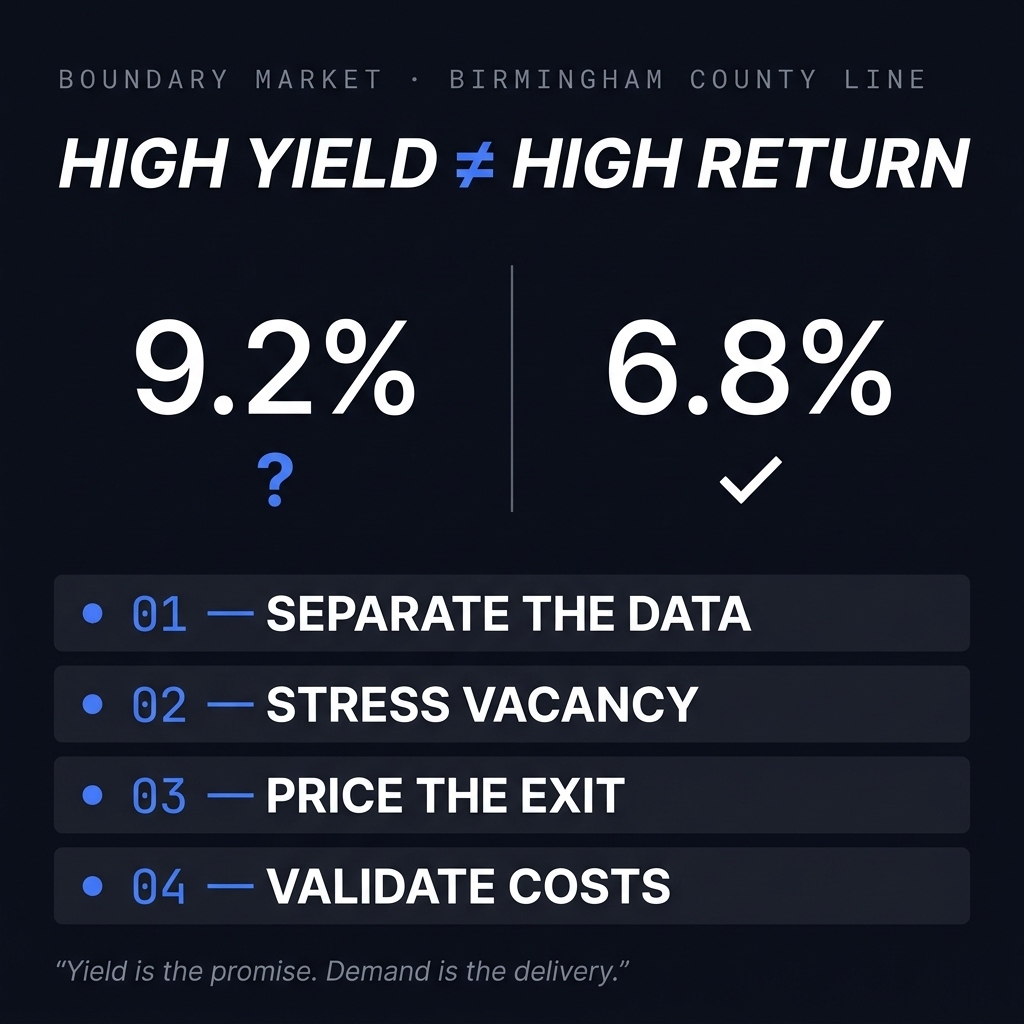
A property with a 7% cap rate looks attractive until you layer in debt service at current rates and discover the cash flow is negligible. Or until you account for a regulatory climate that extends eviction timelines from 30 days to six months, materially changing the vacancy risk that the cap rate doesn't capture.
Cap rates are a comparison tool, not a decision tool.
Both macroeconomic and property-specific characteristics, including supply and demand trends, zoning regulations, credit quality of residents, and specific lease factors, must be considered.
This is why underwriting to a conservative case, rather than a pro forma best case, is what separates a repeatable business from a series of one-off outcomes.
Key Point: A cap rate tells you how a property compares. It doesn't tell you whether to buy it.
The Hidden Cost Trap
Over 42% of small-scale real estate investors admitted to underestimating or completely omitting variable property expenses in their annual budgets, leading to reduced profitability and unexpected cash flow disruptions.
The pattern is consistent: investors celebrate extracting all their cash from a deal while ignoring that refinancing and transaction costs can collectively consume tens of thousands of dollars over time.
Overlooking ongoing expenses is one of the fastest ways to turn a promising deal into a financial problem.
Successful investors know that buying a property is just the beginning of itemized expenses. Small missteps in evaluation or execution compound over time and impact overall returns in ways that aren't obvious at the point of acquisition.
This is where renovation estimates consistently break down for inexperienced underwriting. Scope tends to expand once work begins. A contingency reserve sized to current, not prior-year, contractor pricing is one of the more common gaps in otherwise sound underwriting.
Key Point: The deal you underwrote and the deal you own are only the same if your cost assumptions were built on current reality.
Market Regulatory Climate: The Underweighted Variable
The same problem-tenant situation resolves in weeks in a landlord-friendly state.
In a tenant-friendly one, it can take many months, with materially different cost.
Tenant screening rigor and lease structure decisions should be calibrated to the regulatory climate of the specific market, not applied uniformly across a multi-market portfolio.
Landlord-friendly versus tenant-friendly state law, rent control exposure, eviction timeline, licensing requirements, and short-term rental zoning all directly affect how quickly and cheaply a problem gets resolved.
This variable is frequently underweighted relative to its actual impact on realized returns. A market that scores well on every fundamental but sits in a jurisdiction with extended eviction timelines introduces its own separate risk category that doesn't show up in price-to-rent ratios or cap rates.
Key Point: Regulatory climate is a return variable. Treat it like one.
The Golden Path: A Repeatable Sequence
While the matrix itself isn't linear, there is a repeatable sequence beneath most successful residential deals.
The order in which the matrix's categories typically get engaged, from first contact through disposition or hold:
Market Intelligence → Select market, submarket, asset class
Lead Generation → Source and marketing channel
Seller Qualification → Motivation, equity, timeline
Underwriting → ARV, repairs, returns, risk
Offer Structure → Method, terms, exit plan
Capital Stack → Financing and entity
Due Diligence → Title, inspection, permits
Acquisition → Close and entity vesting
Value Creation → Renovation or stabilization
Lease-Up → Tenant and lease structure
Asset Management → Property management, maintenance, cash flow
Disposition or Hold → Exit timing and tax strategy
The matrix is the full set of options at each step. The Golden Path is the order in which those decisions typically get made.
Confusing the two, locking in financing before underwriting is complete, or selecting an exit before the seller's motivation has been qualified, is a common source of deals that stall midway through the process.
Key Point: The sequence matters as much as the variables. Getting the order wrong creates compounding problems downstream.
Investor Stage: What's Appropriate, and When
Where an investor sits in their own experience curve determines which tools in the matrix are appropriate to use. And which ones carry a meaningfully higher chance of causing damage before the underlying judgment to use them well has been developed.
Beginners (Deals 1-5, roughly 0-3 years) should focus on single-family residences, duplexes, and condos. Financing through FHA, conventional, or VA loans. Strategy: house hack, buy-and-hold, MLS deals. Generally avoid subject-to, hard money, and syndication GP roles.
Intermediate investors (Deals 5-20, roughly 3-7 years) can expand to SFR portfolios, 2-4 units, and distressed properties. Financing through DSCR, hard money, private money, and HELOCs. Strategy: BRRRR, flip, STR/MTR, seller finance. Focus on systems building, entity structure, and tax planning.
Advanced investors (Deals 20+, roughly 7+ years) handle portfolios, build-to-rent communities, and manufactured home parks. Financing through syndication, fund structures, subject-to, and institutional capital. Strategy: portfolio acquisitions, GP/LP structures, 1031 chains. Focus on capital allocation, institutional partnerships, and legacy planning.
This framework isn't a hard gate. It's a risk calibration.
A beginner can learn about subject-to deals or syndication structures without using them. The "avoid" column reflects where the cost of a mistake, made before the underlying experience exists, tends to be highest relative to the deal size involved.
Key Point: Experience isn't just a credential. It's a risk filter that determines which tools are safe to use.
What the Matrix Doesn't Replace
A system map is not a guarantee.
It doesn't substitute for property-specific due diligence, current local underwriting assumptions, or a licensed advisor where tax, legal, or securities questions are involved.
Market conditions, financing availability, and regulatory environments shift. Every category in the matrix, from cap rate assumptions to entitlement timelines, should be re-underwritten against current data before a decision, not assumed from a framework alone.
Several categories warrant individualized professional advice rather than general education.
Creative and seller-financed acquisition structures carry legal and, in some cases, securities considerations that depend on the specific structure used. Tax strategy and legacy planning depend heavily on an investor's individual financial situation.
The matrix's job is narrower and more useful than "tell me what to do."
It's to make sure the variables being weighed are the complete set, not just the three or four that happened to come to mind first.
Key Point: The matrix tells you what to evaluate. Professional advisors tell you how to act on it.
Applying the Matrix to Your Next Decision
The practical value of the matrix shows up when it's run against a specific market or deal, rather than read as theory.
A useful starting sequence:
1. Name the market and cycle stage before anything else. This constrains most of what follows.
2. Identify the target asset class, not just property type. Confirm the intended strategy actually matches it.
3. Qualify seller motivation and equity position before selecting an acquisition method. The two should be chosen together.
4. Underwrite conservatively. Build a contingency reserve on current, not prior-year, cost assumptions.
5. Choose the capital stack deliberately. Understand what each layer costs and what it constrains later.
6. Confirm at least two viable exits before making the offer. Not after.
7. Check the strategy against investor stage. Is this tool appropriate at the current experience level, independent of whether it's sound in the abstract?
Dynamic.RE is built to help investors work through exactly this sequence, turning the matrix's variables into a structured evaluation for a specific market or deal, rather than a mental checklist held loosely in your head.
Run your own property analysis with Dynamic.RE.
Key Takeaways
Asset class, not property type, determines the actual business you're running and dictates tenant profile, capex risk, and rent stability.
Acquisition method sets cost basis and directly constrains future refinancing and exit options. Choose it alongside seller motivation, not after.
Cap rates compare properties. They don't decide whether to buy them. Conservative underwriting requires layering in financing costs, vacancy risk, and regulatory exposure.
Regulatory climate is a return variable that rarely shows up in headline metrics but materially affects realized outcomes.
The hidden cost trap catches most investors because renovation scope expands and contingency reserves are sized to old pricing, not current reality.
Experience level should govern strategy complexity. Advanced tools carry higher risk when the underlying judgment to use them hasn't been developed yet.
The Investor Operating Matrix doesn't replace due diligence or professional advice. It ensures the full set of variables is on the table before the decision gets made.
Frequently Asked Questions
What is the Investor Operating Matrix?
It's a complete decision framework for residential real estate investors, covering 14 categories, more than 80 sub-strategies, and roughly 300 individual variables from market selection through disposition.
Why are cap rates insufficient for real estate decisions?
Cap rates don't account for financing costs, debt service, or regulatory factors like eviction timelines. They're useful for comparing properties, not for evaluating whether a specific deal pencils out.
How does asset class differ from property type?
Property type refers to the physical structure (duplex, SFR, condo). Asset class refers to the income profile of the tenants and the risk-return characteristics of the investment. Two properties of the same type but different asset classes require entirely different operating strategies.
Why does acquisition method matter for exit strategy?
The way a property is acquired sets the cost basis and lien position that constrain future refinancing and resale options. A seller-financed deal with a balloon payment creates a forced exit timeline that a free-and-clear cash purchase doesn't.
What makes regulatory climate a critical variable?
Eviction timelines, rent control laws, and licensing requirements vary significantly by jurisdiction. A landlord-friendly state resolves a problem tenant in weeks. A tenant-friendly state can take months, with materially different financial impact.
How should beginner investors use the matrix?
Beginners should use the matrix to understand the full landscape of decisions without necessarily applying every strategy. The framework helps identify which tools are appropriate at each experience level and which ones carry disproportionate risk before the underlying judgment is developed.
What does "underwriting conservatively" mean in practice?
It means building contingency reserves based on current contractor pricing, not prior-year assumptions. It means stress-testing returns with realistic vacancy rates and financing costs, not best-case projections.
Does the Investor Operating Matrix replace professional advice?
No. The matrix ensures the complete set of variables is identified. Tax strategy, legal structures, and creative acquisition methods all warrant individualized guidance from qualified professionals.
This content is for informational and educational purposes only and should not be construed as investment, legal, tax, or financial advice. Figures and frameworks shown are illustrative and based on general market patterns and assumptions that may not reflect actual results in any specific market or transaction. Real estate investments involve risk, including possible loss of principal. Past performance does not guarantee future results. Investors should conduct their own due diligence and consult qualified legal, tax, and financial advisors before making investment decisions.