TL;DR: Detroit's 48224 ZIP code is a high-yield, low-entry market with strong rent-to-price ratios, but weak demand signals, rising inventory, declining prices, and tenant income constraints require conservative underwriting. Best suited for experienced buy-and-hold investors, not passive or appreciation-focused strategies.
Is 48224 a viable investment market?
Entry costs are low: median owner-occupied home value $88,700 vs. $44,856 median household income (2.0x ratio)
Cash flow potential exists: properties under $80,000 rent for $1,200–$1,400/month
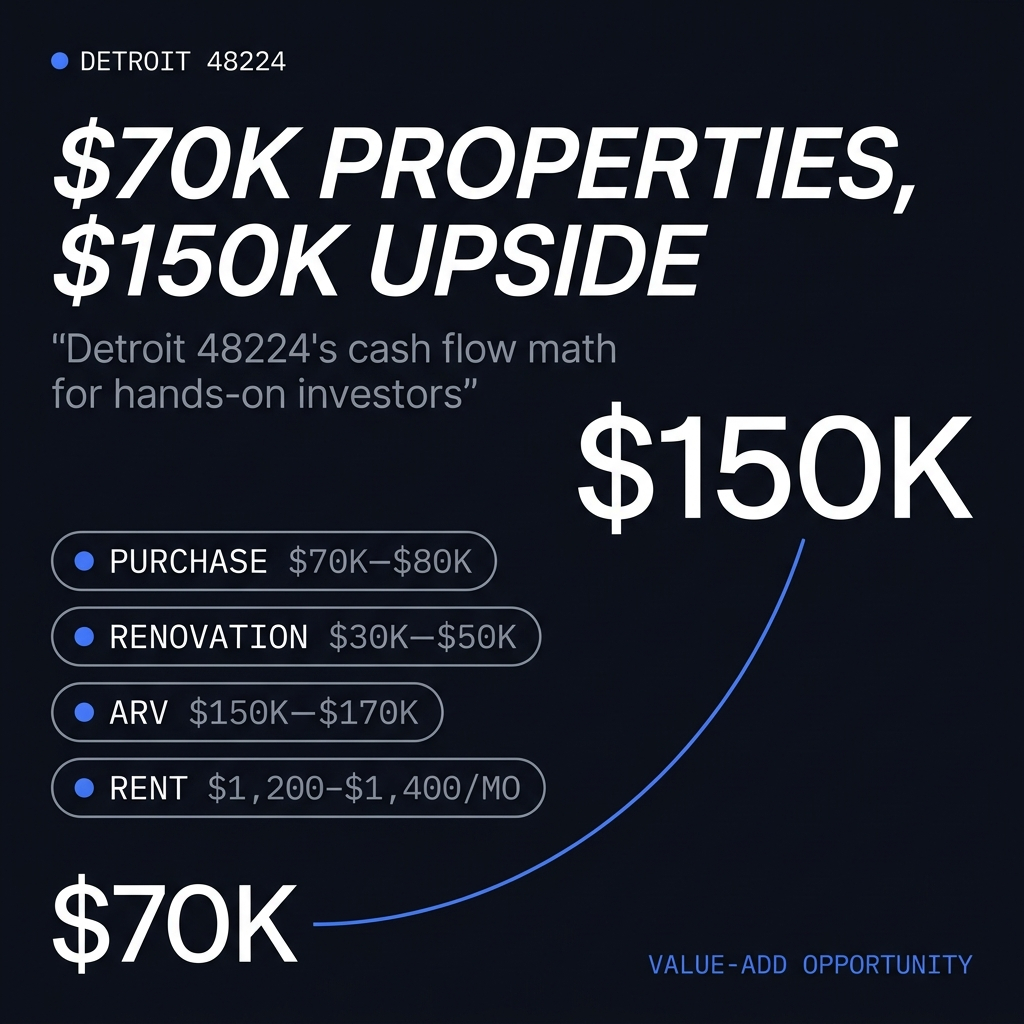
Value-add potential exists: illustrative purchase at $70,000–$80,000, renovation $30,000–$50,000, possible ARV $120,000–$150,000
Primary risk: high renter cost burden limits rent growth potential
Best strategy: buy-and-hold with focus on cash flow, not appreciation
What Are the Key Market Fundamentals in 48224?
Population Trends: Historical Decline, Uncertain Stabilization
The 48224 ZIP code experienced significant demographic contraction. Census Reporter data shows the current population at 39,668 (ACS 2024 5-year estimates).
Historical data from City-Data indicates population peaked around 55,000 in 2000. Most decline occurred between 2000 and 2010. Recent year-over-year changes are less severe, but the trend direction remains uncertain.
Investors should evaluate current fundamentals rather than assuming continued stabilization. The relevant question: does the deceleration continue or does decline resume?
Key Point: Population decline has decelerated compared to 2000–2010, but stabilization is not confirmed. Monitor demographic trends closely.
Income and Housing Affordability Metrics
Median household income in 48224 is $44,856 (ACS 2024 5-year estimates), 44% below the national median of $80,734.
Median owner-occupied home value is $88,700.
The price-to-income ratio in 48224 is approximately 2.0x compared to the national average near 5x. This creates an affordability-focused investment profile. Cash flow takes priority over appreciation potential.
Lower price-to-income ratios create two investor advantages:
Reduced capital requirements for entry
Accessible homeownership for local residents supports stable demand
Key Point: The 48224 market favors cash flow strategies. The low price-to-income ratio enables affordable entry but signals limited appreciation potential.
Rental Market Constraints: Cost Burden Analysis
Rental cost burden data varies by source. Historical estimates suggest a significant portion of renters allocate more than 30% of income to housing costs, meeting the HUD definition of cost-burdened. Investors should verify current renter economics before underwriting aggressive rent growth.
High cost-burden rates, if present, limit aggressive rent increases. Pushing rents higher risks pricing out the existing tenant base and increasing vacancy rates. Investment models should assume modest rent growth. Prioritize stable occupancy over rent escalation.
Key Point: Tenant income constraints cap rent growth potential. Underwrite for cash flow stability, not escalating rental income.
How Has the 2026 Market Shifted?
Early 2026 brought measurable shifts to Detroit's housing market. Inventory increased. Prices declined moderately. Average days on market extended.
Buyers gained negotiating leverage after years of seller-favorable conditions. The market transitioned from competitive bidding to balanced transaction dynamics.
Implications for 48224:
Properties overpriced in 2024–2025 remain unsold. Sellers with liquidity needs show increased flexibility. Value-add investors operating in this environment gain access to better acquisition terms.
Key Point: The 2026 market correction creates acquisition opportunities for disciplined investors. Patience and selectivity are rewarded.
What Are the Value-Add Opportunities in 48224?
BRRRR Strategy: Purchase to Refinance Analysis
Some properties in 48224 may offer value-add potential through strategic renovation. Acquisition prices below $80,000 create opportunities for equity creation post-renovation, but execution risk is substantial.
Illustrative value-add scenario (not guaranteed):
Potential purchase price: $70,000–$80,000
Estimated renovation budget: $30,000–$50,000
Possible after-repair value (ARV): $120,000–$150,000
Estimated monthly rent: $1,200–$1,400
Refinancing at 70–75% loan-to-value on the ARV enables capital recovery while retaining a cash-flowing asset. This supports portfolio scaling through capital recycling.
Execution risks include renovation cost overruns, contractor availability constraints, permitting delays, and inaccurate ARV estimates. Budget contingencies of 15–20% are recommended.
Key Point: Value-add strategies are possible in 48224 but require disciplined execution and conservative ARV estimates. Market conditions in 2026 show rising inventory and declining prices, which affects refinance valuations. Overpaying on acquisition eliminates margin of safety.
Does Location Within 48224 Matter?
Micro-Location Analysis: Eastern vs. Western Boundaries
The 48224 ZIP code borders Harper Woods and Grosse Pointe to the east. Proximity to higher-income adjacent suburbs may influence property fundamentals on a micro-location basis.
Properties near the eastern boundary may benefit from proximity to more stable neighborhoods. Anecdotal evidence suggests streets near renovated corridors perform better than isolated blocks, but performance varies by specific location. Investors should conduct block-level analysis.
Property selection criteria:
Brick construction (higher durability and lower maintenance)
Strong block composition with occupied neighboring homes
Proximity to renovated commercial corridors
Access to major transportation routes and public transit
Avoid blocks with elevated vacancy rates or widespread deferred maintenance on adjacent properties.
Key Point: Location within 48224 matters. Micro-location analysis is required for accurate risk assessment. No blanket assumptions should be made about eastern vs. western performance.
What Do Demographics Tell Investors?
Age and Ethnic Composition
Median age in 48224 is 33.4 years (ACS 2024 5-year estimates). The population is 88.3% Black and 7.8% White.
The relatively young population may correlate with stable rental demand, though tenant turnover rates should be validated locally. Community ties and residential stability vary by neighborhood within the ZIP code.
Providing quality housing at market-appropriate rents enables strong occupancy rates. Tenant screening remains critical. Income verification, rental history, and references are standard practice.
Key Point: Demographics suggest potential for stable rental demand, but local validation is required. Tenant screening remains critical for successful cash flow outcomes.
Which Investment Strategies Work Best in 48224?
Buy-and-Hold Cash Flow Strategy
Acquisitions below $80,000 generating $1,200+ monthly rent create positive cash flow. Long-term holding is supported by cash flow, not appreciation expectations.
BRRRR (Buy, Rehab, Rent, Refinance, Repeat)
Value-add renovations enable equity creation and capital recycling. Success requires efficient renovation execution, strong contractor relationships, and conservative ARV estimates. Target refinancing at 70–75% LTV.
Turnkey Rental Acquisition
Recently renovated properties priced at $100,000–$120,000 reduce execution risk. Cash flow margins are thinner but avoid renovation complexity.
Strategies to Avoid
Speculative appreciation plays are not supported by fundamentals. Investors should not underwrite based on assumptions of doubling property values within five years. The data does not support this thesis.
Key Point: Strategy selection should align with cash flow objectives and renovation execution capabilities. Appreciation is a potential bonus, not the primary thesis.
What Are the Investment Risks in 48224?
Tenant income constraints: Lower income levels and potential high cost-burden rates limit rent growth without increasing vacancy risk.
Renovation cost overruns: Detroit renovation projects frequently exceed budgets. Include 15–20% contingency reserves.
Liquidity risk: The 48224 market shows weakening demand signals. Properties requiring quick sale face extended marketing periods and selective buyer demand. 2026 inventory increases compound liquidity challenges.
Property management intensity: Active property management or strong local partnerships are required. This is not a passive investment market.
Financing challenges: Lenders often apply stricter terms to Detroit properties under $100,000, including higher interest rates and reduced loan-to-value ratios.
Key Point: Risk mitigation requires conservative underwriting, adequate capital reserves, realistic exit timeline assumptions, and recognition of current market headwinds including rising inventory and declining prices.
Who Should Invest in 48224?
Ideal Investor Profile
The 48224 market suits investors who:
Prioritize cash flow over appreciation
Have renovation execution experience or reliable contractor networks
Operate active property management systems
Understand tenant income constraints and their implications
Accept moderate liquidity and longer hold periods
Unsuitable Investor Profile
This market does not suit investors who:
Require rapid appreciation for returns
Prefer passive, hands-off investment structures
Need liquidity options for quick exits
Lack renovation execution experience
Key Point: Investor skill set and capital structure should align with market characteristics. Misalignment increases failure probability.
Frequently Asked Questions
Is 48224 a good area for rental properties?
The 48224 ZIP code offers cash flow potential for experienced investors. Low acquisition costs ($70,000–$80,000) and rents of $1,200–$1,400/month create positive cash flow scenarios. Success depends on renovation execution, property management quality, and rigorous tenant screening.
What is the average home price in Detroit 48224?
Median owner-occupied home value in 48224 is $88,700 (Census Reporter ACS 2024 5-year estimates). Investment properties vary widely by condition and location within the ZIP code.
What are the demographics of 48224?
The population is 39,668 with a median age of 33.4 years. The area is 88.3% Black and 7.8% White. Median household income is $44,856.
How much rent do homes generate in 48224?
Renovated single-family properties may rent in the $1,200–$1,400 per month range, though actual rents depend on property condition, location, and tenant income constraints. Rent growth potential is limited by affordability factors.
What is the BRRRR potential in 48224?
BRRRR strategies are possible when investors acquire properties at favorable prices, execute disciplined renovations, and achieve conservative ARV estimates. Rising inventory and declining prices in 2026 affect refinance valuations. Execution risk is significant and requires experienced contractors and realistic expectations.
Is Detroit real estate a good investment in 2026?
Detroit offers opportunities for specific investor profiles. The 2026 market shift toward buyer-favorable conditions creates acquisition opportunities. Investors should focus on cash flow rather than appreciation. Maintain realistic expectations about rent growth and liquidity.
What are the risks of investing in 48224?
Primary risks include tenant income constraints limiting rent growth, renovation cost overruns, low market liquidity, intensive property management requirements, and stricter financing terms for properties under $100,000.
How do I find good properties in 48224?
Focus on micro-locations near the eastern boundary, brick construction, occupied neighboring properties, and proximity to renovated corridors like East Warren Avenue. Avoid blocks with high vacancy or deferred maintenance.
Key Takeaways
The 48224 ZIP code offers cash flow opportunities at low entry costs, not appreciation plays
Population decline has decelerated compared to 2000–2010, but ongoing stabilization is not confirmed
Value-add strategies are possible with disciplined execution: illustrative acquisition at $70,000–$80,000, renovation $30,000–$50,000, conservative ARV target $120,000–$150,000
Tenant income constraints and potential high cost-burden rates limit rent growth; underwrite conservatively
The 2026 market shows rising inventory and declining prices, creating potential acquisition opportunities but also liquidity risks
Micro-location within 48224 significantly impacts performance; conduct block-level analysis
Success requires hands-on property management, renovation execution capability, and realistic liquidity expectations
Investors prioritizing cash flow and possessing renovation execution capabilities should evaluate 48224 opportunities. Those requiring passive income, rapid appreciation, or high liquidity should consider alternative markets.
Analyze specific properties in 48224 with Dynamic.RE. Compare addresses, estimate cash flow, and validate your investment thesis with real-time market data.
This content is for informational and educational purposes only and should not be construed as investment, legal, tax, or financial advice. Figures shown are illustrative estimates based on historical market data and assumptions that may not reflect actual results. Real estate investments involve risk, including possible loss of principal. Investors should conduct their own due diligence and consult qualified advisors before making investment decisions.