I've been analyzing Michigan's real estate markets for months, and one pattern keeps emerging: the markets with the cheapest entry points have the worst exit conditions.
Flint offers $62,000 median list prices. Detroit gives you $123,000. Both have plenty of motivated sellers cutting prices. But homes sit for 62 to 76 days, and prices are falling 8% to 20% year-over-year.
That's the trap. You buy cheap, spend five months renovating, and your after-repair value erodes while you work.
Warren breaks this pattern.
The Entry Case: Room to Negotiate
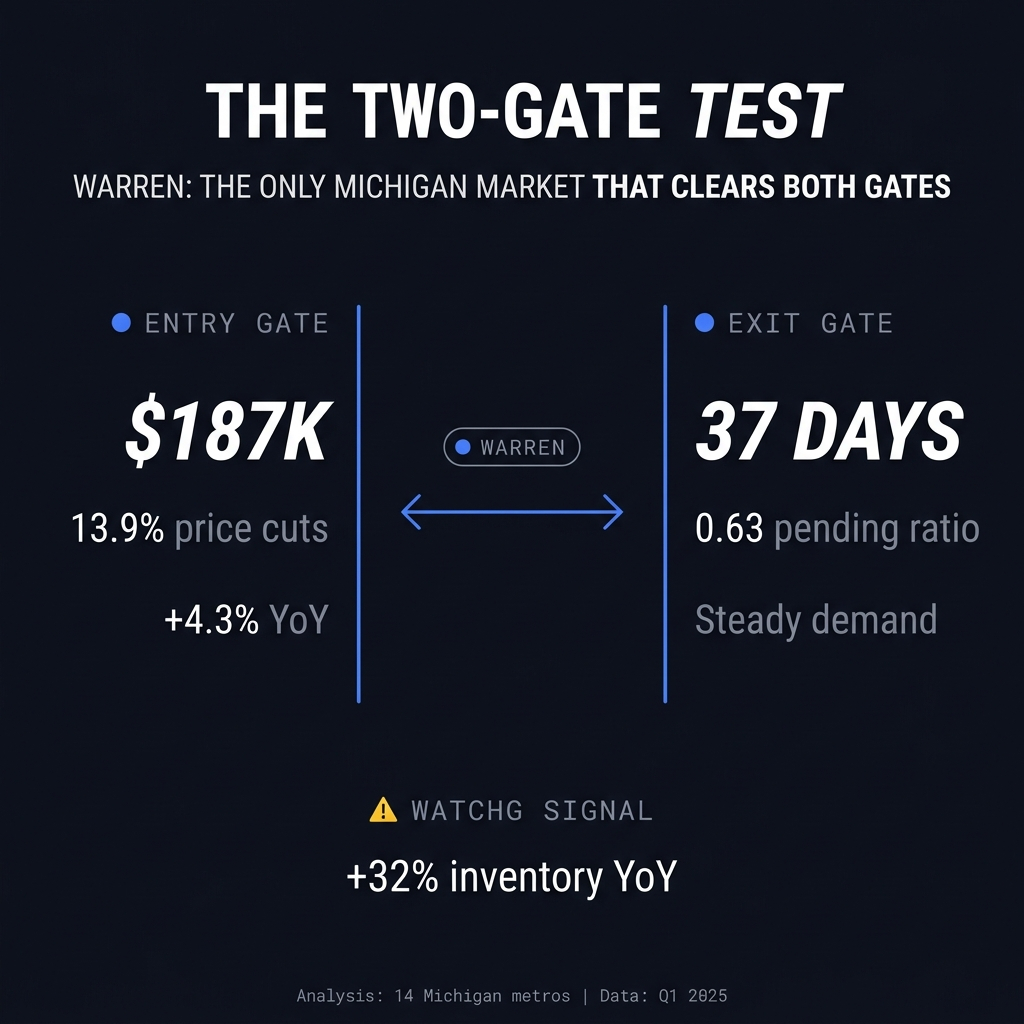
Warren's median list price sits at $187,000. That's working-class affordability without bottom-barrel risk.
More importantly, 13.9% of sellers are cutting prices. That's the second-highest rate among the 14 major Michigan metros I screened. It signals motivated sellers and negotiating room.
You're not fighting a feeding frenzy. You're finding deals.
And unlike markets where price cuts come with collapsing fundamentals, Warren's prices are rising 4.3% year-over-year. That's the critical difference. Sellers are cutting to move inventory in a market that's still appreciating.
The Exit Case: Reliable Demand
Warren homes sell in 37 days. That's faster than the state average and significantly better than the 62-day grind in Detroit or the 76-day wait in Flint.
The pending ratio sits at 0.63. That's not exceptional, but it's functional. Homes are moving from listing to contract at a steady pace.
This is blue-collar Macomb County. Owner-occupant demand. Steady employment. The kind of market where your finished flip doesn't sit because it's priced for real buyers, not speculative investors.
According to Redfin data, properties in Warren receive an average of 3 offers and go pending in around 7 days once they hit the right price point.
The Midwest Advantage in a Compressed National Market
National flip margins hit a 17-year low in Q3 2025. The typical gross ROI dropped to 23.1%, the lowest since 2008.
But geography matters more than ever.
Phoenix flippers post single-digit returns. Austin operators barely break even at $8,844 gross profit. Meanwhile, Cleveland flippers posted a 72% gross ROI—nearly triple the national average.
The Midwest continues to dominate rankings for best states to flip houses due to lower entry barriers. Warren fits this profile perfectly: low enough acquisition cost to control risk, strong enough fundamentals to support reliable exits.
As one industry analysis noted, "Flipping in 2026 is still profitable—but it rewards experience, discipline, and strategy more than ever before."
The Inventory Warning Sign
Warren's inventory is up 32% year-over-year. That's significant.
Rising inventory usually precedes price softening. More supply means more competition for your finished flip. It means buyers have options.
This isn't a deal-breaker yet. Prices are still rising, and homes are still moving. But it's the metric I'm watching most closely.
If inventory continues climbing while days on market start stretching past 45 days, the balance shifts. For now, Warren is still clearing both gates: easy entry, reliable exit.
The Alternative Plays
If you're looking beyond Warren, two other markets deserve attention:
Grand Rapids has the strongest exit demand in the state. Pending ratio above 1.0, inventory actually shrinking 6% year-over-year. But only 8% of sellers are cutting prices, so entry is competitive. You'll win on finding the deal, not on market softness handing you one.
Lansing offers the value play. $151,000 median, 14.5% price cuts, 41-day sales cycle. But inventory is up 81% year-over-year. That's a lot of new supply. Watch this market closely before committing capital.
What to Skip
Ann Arbor is down 20.4% year-over-year with inventory up 49%. That's half a million dollars of capital per deal into a falling market. Wrong risk profile for a flip, even though university town demand keeps homes moving relatively fast.
Detroit and Flint offer rock-bottom entry, but prices are falling 8% to 20% and homes sit for months. These aren't automatic "no" markets, but they require hyper-local, ZIP-code-level conviction. The metro-wide numbers show a falling market.
The Investor Takeaway
Warren is the rare Michigan market that clears both gates right now.
You can buy at a workable price point with real negotiating room. You can exit in a reasonable timeframe into steady owner-occupant demand. Your ARV isn't melting while you renovate.
The inventory trend is the risk to monitor. But for now, Warren offers the most balanced flip opportunity in Michigan.
If you're farming Michigan for deals, this is where I'd start.
Run your own property analysis and compare Michigan markets with real-time data at Dynamic.RE.